October 14, 2026 · Bill Ferguson
The $150 Real Estate Deal: Is It Gold, or Quietly Sinking Your Boat?
"A $150 job for 30 minutes of flying? That's like, $300 an hour! Heck yeah!" Here's a story of us helping an Austin pilot to put their rates into perspective and establish a way ahead.
This one comes from an email one of our users sent in. I'll keep them anonymous to protect the innocent.
"I've been doing $150 jobs for a real estate agent in my area (Austin, TX) that take all of thirty minutes to fly, but I'm losing my rear when I should be making what equates to $300/hr! What's the deal and what am I doing wrong!?"
Short answer: they weren't doing anything wrong with the drone. The work was fine. The problem was the math, and it's a problem a lot of us run into early on in this business.
Let's walk through their real numbers. Math, not guesswork.
The $300-an-hour illusion
Most of us come into this from a W-2 job, where pay is measured by the clock. So when someone offers $150 for a 30-minute flight, the brain does the quick division and hands you a nice little dopamine hit: three hundred bucks an hour. That's lawyer money.
It's human nature. We all want to feel like the hard work of getting a Part 107 certificate has paid off. I'm guilty of doing the exact same thing.
The catch is that the client isn't just paying for 30 minutes of flying. They're paying for whatever it takes to get those photos into their inbox. And until you know what your business costs to run, it's difficult to know whether a job is paying you, or you're paying for the job.
That's how early burnout starts and why so many leave the industry feeling deflated. You're busy, you're flying, and somehow the bank account doesn't seem to agree.
The solution:
Step 1: Find your bottom line
The first thing any small business should know is its bottom line, also called the Cost of Doing Business (CODB). That's the dollars-per-hour figure you can't go below, because anything less loses money. It ONLY covers the bills and keeps the lights on. Zero profit.
We walked this pilot through the free Hourly Rate Builder. It took about five minutes. Here's what went in:
- Drone + payload: $4,500, spread over a 3-year useful life = $1,500/yr
- Insurance: $750/yr
- Software and subscriptions: $600/yr
- Training and Part 107 currency: $200/yr
- Business miles: about 3,000 miles at the IRS standard mileage rate ($0.76/mi for late 2026) = $2,280/yr
- Other overhead (website, phone, LLC fees): $600/yr
Total annual overhead: $5,930.
They were honest about their time commitments and expected to bill about 4 hours a week for 40 weeks, or 160 hours a year. Here's the math:
- Bottom line (floor) = annual overhead ÷ billable hours = $5,930 ÷ 160 = $37/hr
- Required revenue = overhead + target take-home + self-employment tax buffer (15.3%) = $5,930 + $10,000 + $1,530 = $17,460
- Sustainable rate = required revenue ÷ billable hours = $17,460 ÷ 160 = $109/hr
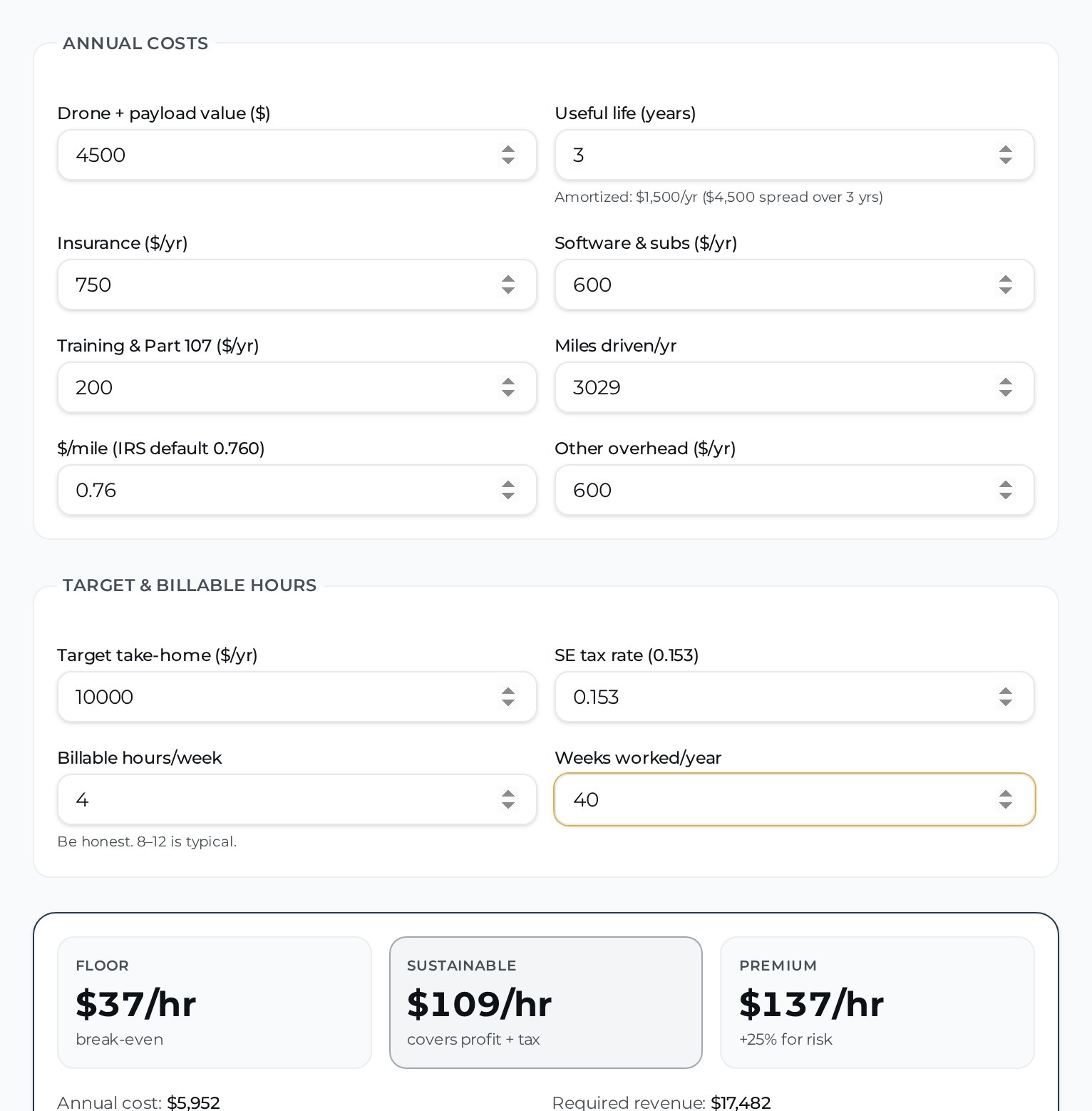
So to clear the extra $10,000 a year they wanted from the side hustle, they needed to average about $109 an hour, or fly more hours if and when they could. And that $37 floor was a number they'd never seen before.
One note: mileage is already baked into that $37. The vehicle's wear and gas are part of overhead, so we're not going to count them twice below.
Step 2: What a "30-minute job" actually costs
Here's where the afternoon really went on a typical shoot:
- Drive: about 40 minutes each way across Austin = 1 hr 20 min
- On site: unload, check airspace, talk to the agent or homeowner, fly the 30 minutes, pack up = 1 hr
- Post-processing: pull the card, cull, edit, export, upload to a gallery = 1 hr 10 min
- Admin: build an invoice from scratch in Microsoft Word, write the delivery email, send it = 30 min
Total: 4 hours. They were only thinking about the 30 minutes in the air.
They also weren't logging their "actuals" (actual numbers) at the end of each mission, so they had no record of how long these jobs really took. (More on that in the Actuals button article .)
Now the real math:
- Real hourly rate = $150 ÷ 4 hours = $37.50/hr
- Margin over the floor = $37.50 − $37 = about $0.50/hr, or roughly $2 for the whole job
And that's before income taxes.
That's not a $300-an-hour gig. That's four hours of work and all you're left with is two bucks in profit when it's all said and done (actually less when you calculate income tax, etc.). Yep. That's the hard reality and that's why they felt like they were busting their butt and not seeing it in the bank account. Another way to look at it, let's flip the script here: for the $150 job to hit their target $109 sustainable rate, the whole job, door to door, would have to take about 1 hour 20 minutes. Remember, the round-trip drive alone was 1 hour and 20 minutes, which leaves zero room for the flight, post-processing and uploading!
Step 3: Is $150 even a fair rate in Austin?
Before you march in and ask for more money, check the other side of the table. Your costs tell you what you need. The local market tells you what the agent is used to paying. You want both before that conversation.
So we looked at what Austin real estate media companies post publicly for drone-only stills (prices as listed in October 2026):
- $125 for 10 drone photos, or $200 for 25, at ZABE Media
- $125 starting price for drone aerials at Studio 12 Austin
- $140 for drone only at Next Aerials
- $175 for 10+ photos, or $245 for 15–25 images, at Austin Real Estate Photography
- $250 for 8–12 aerial photos at Austin 360 Photography
That's a spread of roughly $125 to $250 for a drone-only listing shoot. Our Texas drone services pricing guide puts fuller residential packages (more stills plus some video) at $175 to $475.
So here's the honest read: $150 isn't a lowball. It's on the low side of normal. The agent isn't taking advantage of anybody. They're paying about what the budget shops in town charge.
A few things cut the other way, too:
- Bundles are the competition. Several of those companies toss in drone shots for $60, or even free, when the agent books ground photos with them. A drone-only pilot is up against that.
- Photo count matters. $150 for 10 shots is right in line. $150 for 25 shots plus a short clip is underpriced against the $200 to $245 those shops charge.
- Drive time isn't in anybody's posted price. Most of those shops either work a set service area or price the whole trip in. Our pilot was eating a 40-minute drive each way.
That changes the ask. Instead of "I need double," it's "here's what the market charges for what you're getting, and here's what the drive costs me." Much easier conversation.
How to stop the bleeding
Once the numbers were on the table, some of the frustration went away, because the problem finally had a shape. Here's what they changed.
1. Log actuals on every mission
Tap the Actuals button when the job's done and record the real time on site, in post, and on the road. When you see in black and white that a "quick shoot" keeps eating four hours, you quit treating it like a quick shoot.
Those entries do more than tell you what happened yesterday. Rotor Rate uses your recorded times to build rolling averages from your recent jobs. On future jobs, it can show your average time on site and, for simple data-upload work, your average upload time. The suggestions match the network and type of work where possible. Tap one to use it, or leave it alone if this job's different.
That's the payoff for keeping records: the next estimate starts with what your work has actually taken, not what you hope it'll take. It isn't a promise that the next job will match the average. It's a nudge backed by your own history.
For this pilot's direct-client shoots, a notebook or spreadsheet can show the same pattern. The habit matters either way: log the time, compare similar jobs, and use what you learn on the next quote.
2. Put a radius on the price
That $150 can work just fine close to home. Past a set distance, add a trip fee that covers the drive time. Something like: "My base rate covers shoots within 15 miles. Out in Dripping Springs or Round Rock, travel adds $X." You're not being greedy. You're pricing the whole trip instead of just the flight.
3. Chain missions in the same area
This is a big one. If the agent has three listings on the same side of town, fly them the same morning. The 80-minute drive gets split across three invoices instead of eaten by one.
Same assumptions, three stacked shoots:
- Drive: 1 hr 20 min total (shared)
- On site + post + admin: 3 jobs × about 2 hrs 20 min = 7 hrs
- Total: about 8 hrs 20 min for $450 = about $54/hr
Still short of $109, but now you're well above the floor and actually putting money in your pocket. Ask the agent to batch listings, or look for other work nearby to pair up with. Rotor Rate lets you link missions into a chain so the shared drive shows up in the math instead of being counted three times. For the bigger version of this, see How to Price and Quote Multi-Site Drone Jobs .
4. Stop building invoices the archaic way
Half an hour on a Word invoice for a $150 job is a big slice of your margin. Hopefully you hit save before exiting. If the client's already saved in Rotor Rate, the invoice is just a couple of clicks.
5. Have the real-numbers conversation
With their own floor, their sustainable rate, and the local comps in hand, this pilot sat down with the agent and had an honest conversation: here's what a shoot actually costs me, here's the drive, and here's what other Austin shops charge for the same photos. If your rate is already above the local range, you'd lean on chaining and travel fees instead of a price bump. If it's below, the comps make the ask for you. No apologizing, no guessing. Just the math. And because they'd built a solid, professional working relationship, the agent listened. They struck an agreement that worked for both of them. That's what knowing your numbers buys you: not a confrontation, a conversation.
None of these fixes gets you to $109 alone. Stack two or three of them and the picture changes fast.
Run your own numbers (it's free)
The Hourly Rate Builder and the drone services pricing calculator are free for anybody to use. No account, no credit card. Plug in your own gear, insurance, miles and hours, and you'll have your bottom line in about five minutes.
Your numbers won't match this pilot's. Your insurance, your drive, your hours are yours. That's the whole point.
The takeaway
There's nothing wrong with a $150 real estate job. Three of them in the same area in one morning can be a decent day. One of them 40 minutes away might be a donation depending on your numbers.
Know your floor. Price the whole trip, not just the flight. And when an offer looks like $300 an hour, run it through the pricing calculator to see what the reality is (for you) before you say yes.
Sources & further reading
- ZABE Media — Austin real estate drone photography pricing, October 2026
- Studio 12 Austin — Austin drone aerial pricing, October 2026
- Next Aerials — Austin real estate media pricing, October 2026
- Austin Real Estate Photography — Austin drone photo and video pricing, October 2026
- Austin 360 Photography — Austin aerial photography pricing, October 2026
- IRS — Standard mileage rates
Related guides
Go deeper on the rest of the drone-pricing topic — same framework, different angle.
Swipe for 4 links →
How to Price Drone Services
The eight factors and bid formula behind every defensible quote.
Drone Photography Pricing hub
Real-estate, brand, and event photo rate ranges with the math behind each.
Drone Mapping Pricing hub
Per-acre rates, processing time, and how to tier large-area jobs.
Drone Inspection Pricing hub
Tower, roof, solar, and infrastructure inspection rate ranges.
Next steps
What to do once you have a number you trust.
Swipe for 2 links →