June 19, 2026 · Bill Ferguson · Reviewed September 6, 2026
When to Raise Drone Rates: Signals & Benchmarks
A lot of pilots raise their rates too late, by gut feel, or never at all. Here's a clean framework for reading the signals — win rate, market drift, cost creep, real take-home — plus the traps that talk people into the wrong kind of price hike.
Raising your rates is one of those things every drone operator knows they should do "eventually," but when exactly is that? By the time most of us get around to it, we've already left money on the table — or worse, we've raised at the wrong moment, killed a productive lane, and quietly had to walk it back a few weeks later.
This post is a no-fluff framework for that decision. What signals actually mean raise, what signals are noise, what benchmarks to glance at, and the traps that talk people into the wrong move in either direction. And because some of this work happens for you automatically inside the paid version of Rotor Rate, I'll show you the nudge it pops up when the math says it's time.
The four signals that actually mean "raise"
There's noise that feel like signals — "I'm tired of doing x," "this client is beginning to annoy me," "the guy down the road just bought a Matrice 4." Ignore those. The signals that matter are measurable and boring. Raise your rates on factual data, not feelings or noise.
1. A win rate that's too high
If you're winning more than ~70% of the bids/offers you submit, you're almost certainly underpriced. That sounds counterintuitive — winning a lot is good, right? — but a healthy business loses some quotes on price. If you're not, your number is below what the market will tolerate, and every "yes" you get is leaving some profit margin on the floor.
The math people miss: at $200/job and a 90% win rate, you might be billing the same as $260/job at a 70% win rate, with fewer jobs, less wear, and more time recovered. The higher number is almost always the better business.
Healthy band: roughly 45–65% win rate on the bids you actually quote (not on every lead, not on jobs you no-bid). Above 70% is a raise signal. Below 30% is a different problem entirely.
2. Awarded bids coming in below the benchmark
When the majority of your awarded jobs are landing below the low end of the regional industry benchmark for that work, you're not "competitive" — you're subsidising the client. The benchmark already includes the discount operators are willing to give for volume; you're going under that. This is the arena most new drone operators fall in to; note: the Rotor Rate free calculator was made available to everyone to prevent this very thing from happening.
Watch for this pattern especially in lanes you're newest in. Operators routinely under-quote unfamiliar verticals out of impostor syndrome, then bake that under-quote into their permanent price.
3. Realised $/hr that's drifted below your floor
Your hourly rate on the quote is fiction — an estimate based on your best guess at the time. Your hourly rate after fuel, drive time, processor fees, platform cuts, and the 45 minutes of post you forgot to charge for is the truth (aka the 'Actuals' button/inputs ). If that realised number sinks below the break-even floor you calculated when you set up your business (covered in detail in the hourly-rate post ), you're losing ground in real time.
This is the most important signal of the four because it's the only one that's denominated in your money, not in industry averages. This is also where the discipline of using the Actuals button on every mission is critical to keeping your rates honest.
4. Cost creep on the input side
Insurance went up. Gas went up. Software and subscriptions went up. You added a payload. You moved to a more expensive market. None of these justify a raise on their own, but together they pull your floor up, and a year of "small" creep can quietly raise your break-even by 15–20% without you noticing. Re-do your fixed-overhead math once a year — if your floor moved, your rate has to move with it.
What the pricing-review nudge in Rotor Rate is watching
You don't actually have to track most of this yourself. Rotor Rate is running this evaluation in the background every time you save or update a job, and surfaces a nudge when two specific signals fire:
- High win rate — when you have at least 10 awarded bids in your last 20 decided jobs and your win rate is above 70%.
- Below benchmark — when at least 5 of your last 10 awarded jobs had an industry benchmark attached, and 60%+ of them landed below the low end of that benchmark.
When either fires, you'll see this inside your Workspace:
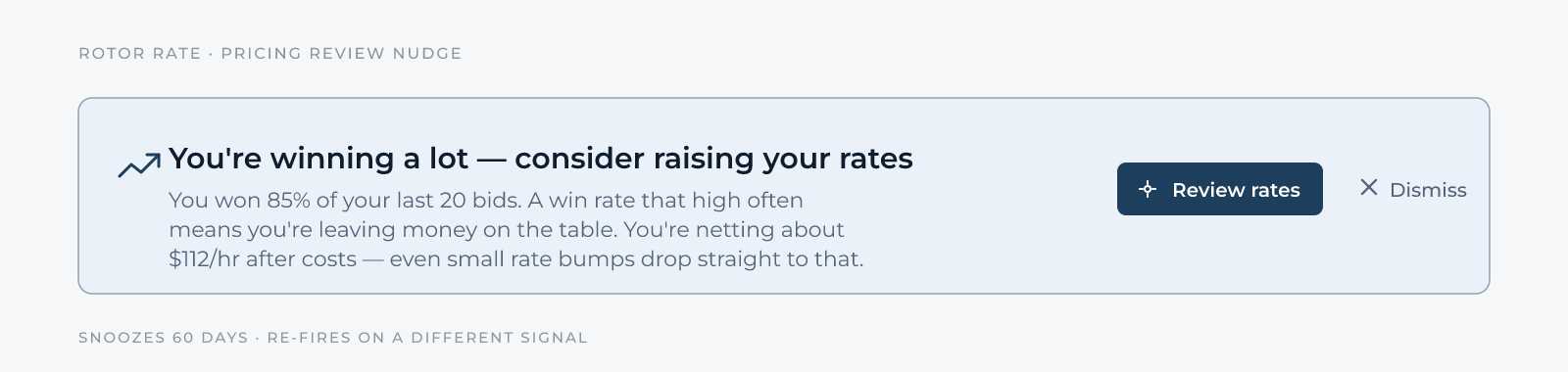
A few things to know about how it behaves so you trust it:
- Win rate beats benchmark. If both signals are present, Rotor Rate shows the win-rate version because it's the stronger "you could charge more" signal. Telling someone with a 35% win rate to raise prices would be malpractice.
- It quotes your realised $/hr in the copy. Once you have 3+ completed missions logged, the nudge tells you what you're actually netting per hour after fuel, drive time, and Internal Revenue Service (IRS)-rate vehicle costs — not what your hourly rate input says. That's the number that should move you.
- Dismiss snoozes for 60 days, so it doesn't become wallpaper. You won't get nagged every login.
- A different signal defeats the snooze. If you dismiss a benchmark nudge in March and your win rate spikes in May, the banner reopens. The two triggers are tracked separately on purpose — they're telling you different things.
- It's read-only. The nudge never changes your rate. It opens the rate settings dialog and lets you make the call. The app's job is to surface the signal honestly; the decision is yours.
If you've never seen this banner, that's fine — it means neither trigger has fired. But it also means you should still glance at the signals manually every quarter, because the triggers are conservative on purpose. They'd rather miss a quiet "you could raise 5%" than yell at you for a one-month outlier.
Industry benchmarks to glance at (and what to ignore)
When you're trying to gut-check whether a raise is reasonable, the temptation is to compare yourself to the loudest voices on Reddit and Facebook groups. Don't. Those numbers are wildly distorted — the people charging $1,200 for a shoot post about it, the people charging $250 don't.
Better references:
- Rotor Rate's benchmark panel for your industry + city + region + payload combo. It pulls from operator data, directories, and industry reports and caches it for 30 days. Use low/avg/high as a range, not a target.
- Droners.io and FlyGuys public quote ranges for your vertical. These are real, recent, market-clearing numbers — closer to truth than forum talk.
- Local AEC / Geographic Information System (GIS) RFPs that have been publicly posted. These show what commercial buyers are willing to pay, which is usually higher than residential.
- Industry reports (Skylogic, DroneAnalyst, etc.) — directional, not surgical. Useful for "is my whole vertical trending up?" questions, not "should I charge $300 or $325?"
What to ignore: anyone telling you a single number for "what to charge for X." Pricing is a function of your market, your gear, your overhead, your deliverable, and the buyer's alternatives. There is no national number.
The five traps
This is where most of the bad raises happen.
Trap 1: Raising on emotion, not evidence
You had a frustrating week. The client haggled. The drive was awful. None of that is a pricing signal. Wait two weeks and look at the numbers. If they still say raise, raise.
Trap 2: Raising the wrong lane
Operators often raise across the board when only one vertical actually justifies it. If your inspection work is winning 85% and your real estate work is winning 40%, raising real estate is going to nuke that lane. Raise per vertical, and use the benchmark panel for each.
Trap 3: Raising during a soft season
If your local market has clear seasonality (most do — winter for outdoor work in the north, summer for indoor inspections in the south), don't raise headed into the soft season. The market is about to test you on price anyway; let it. Raise headed into your strong season, when you can afford to lose a few price-sensitive deals.
Trap 4: Raising past a psychological number without changing the deliverable
There are price ceilings where buyers re-evaluate you. Going from $475 to $525 isn't the same as going from $475 to $495 — the $500 line makes the buyer ask "what am I getting for this?" If you cross a psychological ceiling, also upgrade the deliverable (better report template, faster turnaround, additional asset). Give them the answer to the question before they ask it.
Trap 5: Raising and not telling repeat clients
This one is a relationship killer. If you have repeat clients on an implicit rate, raising silently on the next quote feels like a bait-and-switch even when the new number is reasonable. Send a short, factual email a month before: "Heads up — effective [date], my rates are moving from X to Y. Anything booked before then stays at X." Most clients respect this and stick. The ones who leave were going to leave anyway.
When to hold the line instead
Sometimes the right move is not to raise even when one signal says you could.
- You're still building a portfolio in a vertical. First 10 jobs in a new lane are at-cost or near-cost on purpose. The deliverables are the asset. Don't raise out of a lane you haven't earned yet.
- You're running a loss leader by design. Some operators take real estate at market or below specifically to be on the GC's vendor list for inspection work that pays 3x. If the loss leader is doing its job, leave it alone.
- Your win rate is high but your absolute volume is low. A 90% win rate on 6 quotes a year is not a "you're underpriced" signal — it's a sample-size problem. Get to at least 20 decided bids/offers before you trust the number.
- Your costs went up but the market's didn't. If your overhead climbed but local competition's pricing is flat, raising puts you out of band. Look at why your costs grew — maybe the right move is to fix that side first.
The short version
- Re-do your floor every 6 months. If costs crept up, your rate has to.
- Watch four signals: win rate, benchmark position, realised $/hr, cost creep.
- Let the Rotor Rate banner do the watching on the first two for you.
- Raise by vertical, not by app.
- Raise into your strong season, not your soft one.
- Tell repeat clients before the new number hits their inbox.
- When in doubt, raise 5%. The world will not end. You can always pull it back.
Set a recurring reminder right now to revisit this in 90 days. Most operators don't do this and time slips past (especially when we get busy), set the calendar reminder and put it on repeat before a year goes by and you're cursing yourself for not styaing on top of your pricing. Small-and-often wins.
— Bill
Sources & further reading
The signals and benchmarks above lean on a mix of operator data, industry reports, and broader pricing research. If you want to dig deeper into any one piece:
Pricing fundamentals
- McKinsey & Company — *The power of pricing*. The foundational piece on why a 1% price improvement outperforms equivalent gains in volume or cost reduction.
- Harvard Business Review — *Pricing strategy topic hub*. Long-running collection of pricing articles, including pieces on price ceilings, anchoring, and communicating raises to existing clients.
Drone industry data
- Drone Industry Insights (DroneII) — annual market reports, vertical breakdowns, and operator surveys.
- DroneAnalyst / Skylogic Research — long-running industry analyst with operator pricing data.
- Droners.io — public job board where you can scan recent bid ranges by vertical and region.
- FlyGuys — pilot network with published service tiers and deliverable definitions worth using as a reference point.
Cost inputs that move your floor
- Internal Revenue Service — *Standard mileage rates*. Authoritative source for the per-mile vehicle cost used in your break-even floor calculation (2026 business rate: $0.725/mile).
- U.S. Energy Information Administration — *Gasoline and Diesel Fuel Update*. Weekly retail fuel prices, useful for spotting cost-creep on signal #4.
Rotor Rate companion reads
- Building your hourly rate * — how to set the break-even floor that signal #3 is measured against.
- From estimate to reality: how the Actuals button locks in your true profit * — the discipline of logging realised cost and time on every mission so signal #3 stays honest.
- Why most drone quotes lose money * — the upstream mistakes that push realised $/hr below floor in the first place.
- Setting your walk-away floor * — knowing the number you won't go below, regardless of which signal is firing.
<!-- auto-freshened: 1.5, v1.12 on 2026-08-07 -->
Related guides
Go deeper on the rest of the drone-pricing topic — same framework, different angle.
Swipe for 4 links →
Why Most Drone Quotes Lose Money
The hidden costs that quietly turn a profitable-looking bid into a losing job.
Industry Benchmarks: Where the Numbers Come From
What the low / average / high actually mean and how much to trust them.
Network vs. Direct Clients: The Real Pay Difference
What each model actually pays in 2026 and the mix that funds a real drone business.
How to Price Drone Services
The eight factors and bid formula behind every defensible quote.
Next steps
What to do once you have a number you trust.
Swipe for 3 links →
Drone Hourly Rate Calculator
Back into a defensible $/hr from your real costs, target take-home, and billable hours.
Open the bid & profit calculator
Plug in your job, gear, and overhead. Get a defensible price, real profit, and an industry benchmark.
See Rotor Rate pricing & start a free trial
Save jobs, history, and benchmarks. Free to try, no card required.