October 20, 2026 · Rotor Rate · Reviewed November 6, 2026
From RGB to Thermal: Is the Move Worth It for Commercial Drone Pilots in 2026?
A numbers-first guide for pilots thinking about adding thermal (heat-imaging) work to a regular camera business — gear cost, training, the editing changes, the rate premium, the pitfalls, and a realistic break-even for 2026.
Should you move from RGB and mapping to thermal?
Most commercial drone pilots start in the visible spectrum — Red, Green, Blue (RGB) photo and video, plus orthomosaic mapping for surveyors and contractors. After a year or two of real estate, marketing, and the occasional roof job, the same question always surfaces: is it time to add a thermal payload? Thermal — sometimes called Infrared (IR) or Long-Wave Infrared (LWIR) — opens doors to solar inspections, building envelope audits, electrical and mechanical inspections, search and rescue support, and roofing moisture surveys. It also costs real money, requires new training, and changes how you price and deliver work.
This article walks through the gear math, the education path, the missions worth chasing, and what a realistic rate premium looks like — so you can decide whether the jump is worth it for your business.
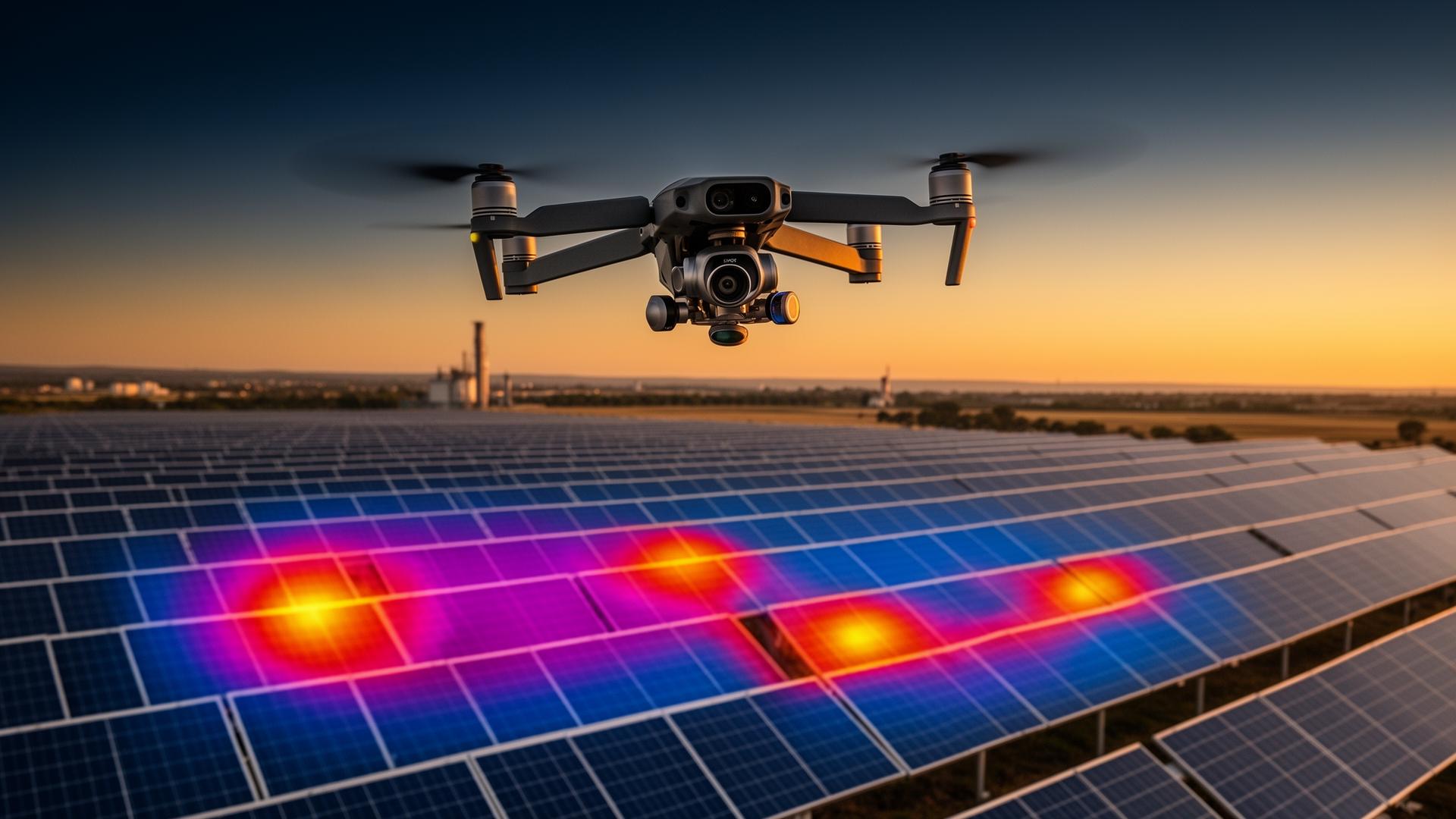
The gear: what "going thermal" actually costs
There are two practical paths:
- Buy an integrated dual-sensor enterprise drone. The DJI Matrice 4T ships with a 48 MP wide RGB camera, a tele lens, and a 640×512 radiometric thermal sensor in a single gimbal. Street price as of late 2025/early 2026 sits around $6,500–$7,500 for the airframe, depending on bundle. The Matrice 350 RTK paired with a Zenmuse H30T (1280×1024 thermal) runs $15,000–$22,000+ depending on cells, charging hub, and accessories.
- Add a standalone radiometric payload to an existing platform. A Skydio X10 with the VT300-L thermal module, or a Freefly Astro with a Boson-class payload, lands in the $11,000–$30,000 range fully kitted.
Whatever path you pick, budget for the whole stack, not just the airframe:
- Airframe + dual sensor: $6,500–$22,000
- Spare smart batteries (3–6): $1,200–$3,600
- Multi-bay charging hub + case: $400–$1,000
- Calibration blackbody source or known-emissivity reference plate: $300–$2,500 (only required for some quantitative work)
- Thermal post-processing software (DJI Thermal Analysis Tool is free; FLIR Thermal Studio Pro is paid): $0–$1,000/yr
- Solar-specific reporting software (Raptor Maps, Sitemark, Scopito): $1,500–$8,000/yr if you want client-ready Performance Ratio (PR) and serial-number-tagged defect reports
- Insurance rider bump for added hull value: typically 5–10% of new hull value annually — see our breakdown in drone pilot insurance cost
Realistic all-in entry: about $9,000–$12,000 to start with a Matrice 4T and basic free software; $25,000–$35,000 for a Matrice 350 RTK / H30T setup with paid analytics. Compare that to our scaling drone hardware: prosumer to enterprise guide for the broader hardware-progression context. You can save these kits as Equipment presets in Rotor Rate to quickly add them to new job estimates.
Education and certification: what's actually required vs. nice-to-have
In the United States, the Federal Aviation Administration (FAA) Part 107 certificate is the only legal requirement to fly a thermal payload commercially. There is no separate FAA "thermal endorsement." But clients — especially industrial and insurance clients — will ask for proof you know what you're doing with the radiometric data. The three credentials that actually move rates (and can be applied as a Thermographer multiplier in the Rotor Rate Refine & plan panel):
- Infraspection Institute — Level I Certified Infrared Thermographer. ~32-hour course, online or in-person. Tuition runs $1,800–$2,200; Level II adds another $1,800–$2,200. Source: infraspection.com.
- American Society for Nondestructive Testing (ASNT) — Infrared and Thermal Testing per SNT-TC-1A. Used heavily by industrial clients; certifying agencies typically charge $1,500–$3,000 for Level I prep + exam.
- Vendor-specific solar inspection training (Raptor Maps Academy, Heliolytics workflow training, Sitemark certified inspector). Often free to $1,200, and sometimes required to be added to a network's approved-pilot list.
Optional but well-regarded:
- United Infrared (UI) Drone Thermographer course — drone-specific, ~$1,000–$1,500
- DroneDeploy / Pix4D / Esri ArcGIS thermal-workflow webinars — usually free
- Building Envelope Specialist (BES) supplemental training if you plan to chase commercial roof moisture surveys (~$800–$1,500)
Realistic education budget to be taken seriously by industrial clients: $2,500–$5,000 plus 40–80 hours of study and shadowed flights.
What changes in your post-processing workflow
If you're flying for a network — Zeitview (formerly DroneBase), Heliolytics, DroneUp — they often supply the flight plan, post-processing pipeline, and deliverable template. You fly to spec, upload the raw radiometric Joint Photographic Experts Group (R-JPEG) files, and the network does the analytics. Easy, but the rate reflects it. For direct clients, the workload shifts onto you:
- Flight planning is stricter. Solar inspections typically require an irradiance threshold of 600 W/m² (watts per square meter) per the International Electrotechnical Commission (IEC) Technical Specification 62446-3, plus a sun angle and Ground Sample Distance (GSD) that resolves a single photovoltaic (PV) cell — usually ≤3 cm/pixel for diagnostic-grade work, ≤5 cm/pixel for screening. Source: IEC TS 62446-3.
- Radiometric files are larger and slower. Expect roughly 2–3× the storage of an equivalent RGB mission, and 30–60% longer processing per acre in DJI Thermal Analysis Tool, FLIR Thermal Studio, or a solar-analytics platform.
- Reporting is the deliverable, not the imagery. Direct industrial clients want a defect list with severity tier (IEC TS 62446-3 categorizes anomalies into classes), Global Positioning System (GPS) coordinates per defect, serial-number tagging when readable, and a Performance Ratio (PR) impact estimate. When quoting, use the Processing & deliverables picker in Rotor Rate to add a 'Thermal report' as a line item to ensure your post-processing hours are covered.
- Roof and building work needs an emissivity note and ambient capture. Document air temperature, wind, recent rainfall, and roof surface emissivity assumption (commonly 0.92–0.95 for most membranes) — it protects you if a defect call is later challenged.
If you haven't yet built a defensible per-deliverable rate, our drone post-processing pricing per industry rate guide is the right starting point — the same logic applies, but with thermal multipliers layered on top.
The rate premium: what thermal actually pays vs. RGB
Real, defensible 2026 ranges based on direct-client work and current network published rates:
- Residential roof — RGB-only visual: $150–$350 flat (see full roof inspection breakdown )
- Residential roof — RGB + thermal moisture overlay: $300–$650 flat
- Light commercial roof — RGB-only: $400–$900
- Light commercial roof — RGB + thermal moisture survey with report: $850–$2,200
- Solar — utility-scale screening flight, network-supplied: $30–$55 per Megawatt (MW) (you fly, they process)
- Solar — utility-scale full diagnostic, direct client with your report: $120–$280 per MW
- Solar — commercial rooftop (50 kW–2 MW), direct client: $450–$1,800 flat per site
- Electrical substation or industrial site walk-around: $600–$2,400 per visit
- Search and rescue / public safety call-out (per-event contracted): $250–$650 per hour on-scene; many pilots donate this and bank the brand value
Effective premium over RGB-equivalent work: roughly 1.5× to 3× the RGB rate for the same site, once you're delivering an actual report — not just handing over imagery. Network rates compress that premium toward 1.2–1.5×; direct clients are where the 2–3× lives. We dig into the network-vs-direct math in first direct drone clients playbook . When bidding, remember that Rotor Rate now automatically covers card-processing fees in your fair rate so your margin stays intact.
The realistic break-even math
Here's a worked example so the numbers feel real. Assume you add thermal capability with a Matrice 4T setup:
- Total upfront capital: $11,000 (airframe + batteries + case + software year 1)
- Education and certification: $3,500 (Infraspection Level I + Raptor Maps onboarding + travel)
- Insurance rider increase: ~$400/yr
- All-in year-one cost to be "thermal-ready": roughly $14,900
If you book one commercial roof moisture survey per month at $1,400 avg (a conservative direct-client number for a single warehouse roof), that's $16,800/yr in thermal-attributable revenue. Year one breaks roughly even; year two onward the gear is mostly paid off and the same one-job-per-month cadence is close to pure margin minus your time, post-processing, and the $400/yr insurance bump.
Add one small commercial solar inspection per quarter at $1,200 and you're at $21,600/yr — that's a respectable side stream layered on top of an existing RGB business. Hit two solar jobs per month in a solar-heavy state (California, Texas, Arizona, North Carolina, Florida) and the same payload starts to look like a primary revenue line.
Pitfalls — the stuff that bites pilots who jump too fast
- Quoting "thermal" without quoting the report. Clients don't pay for false-color JPEGs. They pay for findings. If you don't have a report template before the first job, you'll lose hours after the flight and resent the project. You can now send branded client estimates directly from Rotor Rate to professionalize this scope.
- Flying solar at the wrong irradiance. Below ~600 W/m² your defect calls aren't defensible. A morning flight with thin overcast can invalidate the whole survey. Carry a pyranometer or pull from a nearby weather station and log it in the report.
- Ignoring emissivity on roofs. A white Thermoplastic Polyolefin (TPO) membrane and an aged Ethylene Propylene Diene Monomer (EPDM) roof are not the same emissivity. Wrong setting, wrong temperatures, wrong conclusions.
- Assuming the network rate is the market rate. Network jobs are a great way to get reps. They are a terrible benchmark for what direct clients will pay — typically 30–50% less. Use the Pass Log to track these low-ball offers and see how they stack up against your fair rate.
- Skipping the calibration/check-shot habit. A simple known-temperature reference (a bucket of ice water or a calibrated blackbody) shot at the start and end of each mission saves arguments later.
- Pricing the post-processing as if it's free. Use the same fair-rate logic from our setting your range and walk-away floor on Rotor Rate guide — itemize your reporting time as a deliverable add-on so it is clearly invoiced.
Industry numbers worth knowing
- The U.S. Bureau of Labor Statistics (BLS) groups most commercial drone work under Standard Occupational Classification (SOC) code 53-2012 (Commercial Pilots) or 49-9071 (Maintenance and Repair Workers, General) — there is no dedicated thermography Standard Occupational Classification (SOC) code yet, so wage data is noisy. Source: bls.gov/oes.
- The U.S. solar industry installed a record amount of capacity in 2024 — the Solar Energy Industries Association (SEIA) / Wood Mackenzie U.S. Solar Market Insight tracks the operational base, which is the addressable market for recurring inspection work. Source: seia.org/us-solar-market-insight.
- The National Renewable Energy Laboratory (NREL) "Best Practices for Operation and Maintenance of Photovoltaic and Energy Storage Systems" recommends infrared thermography as a standard PV inspection method, which is the document many utility-scale Operations and Maintenance (O&M) contracts cite. Source: nrel.gov/docs/fy19osti/73822.pdf.
- For mileage and travel cost on thermal jobs (which often pull you further from home than RGB real estate work), use the 2026 Internal Revenue Service (IRS) business standard mileage rate of $0.76/mile (from July 1, 2026; it was 72.5¢ January–June). In Rotor Rate, you can now toggle between one-way or round-trip mileage entry to match your workflow.
Free resources before you spend a dollar
- NREL Best Practices for Operation and Maintenance of Photovoltaic and Energy Storage Systems (free PDF): nrel.gov/docs/fy19osti/73822.pdf
- IEC TS 62446-3 abstract and outline (the global standard for PV thermal inspections): webstore.iec.ch/publication/28628
- DJI Thermal Analysis Tool (free radiometric R-JPEG editor): dji.com/downloads/softwares/dji-thermal-analysis-tool
- FAA Part 107 study guide (still the legal foundation): faa.gov/uas/commercial_operators
- Rotor Rate calculator for sanity-checking your thermal-job rate against your true cost-of-doing-business floor: /calculator. The free trial is now 60 days and no longer requires a credit card to start.
So — is it worth it?
For most pilots, the honest answer is yes, but not immediately, and not for everyone.
Thermal pays off fastest if you already have:
- A direct-client book of business (not pure network work)
- A geographic footprint with utility-scale solar, large commercial roofs, or industrial Operations and Maintenance (O&M) contracts in driving distance
- The discipline to build a real report template and not just hand over imagery
- A finance cushion to absorb $10K–$30K of capital that may take 12–18 months to recoup
Thermal does not pay off if you're chasing residential real estate as your primary line, if you're allergic to writing reports, or if your local market is saturated with experienced thermographers already on long-term Operations and Maintenance (O&M) contracts.
If you're earlier in the journey, work the drone hobby → side hustle → full-time business progression playbook first. Stabilize the RGB business, build the direct-client muscle, then add thermal as the second revenue stream — not the first.
Either way, model the numbers honestly before you swipe the card. The pilots who win at thermal aren't the ones with the best sensor — they're the ones who priced the work, sourced the clients, and built the report before the drone ever left the case.
Sources & further reading
Thermal work pulls from sensor science, vendor specs, and inspection-market analysis:
Sensor & measurement primary sources
- NASA Earth Observatory — *Remote sensing — Earth Observatory feature
- NIST Physical Measurement Laboratory — *Sensor Science — measurement laboratory
Enterprise platforms
- DJI — *DJI Enterprise platforms
- Skydio — *Skydio X10 enterprise drone
Industry data
- Drone Industry Insights (DroneII) — *Drone Industry Insights — market reports
- Skylogic Research — *DroneAnalyst / Skylogic Research
Rotor Rate companion reads
Related guides
Go deeper on the rest of the drone-pricing topic — same framework, different angle.
Swipe for 4 links →
How to Price Drone Services
The eight factors and bid formula behind every defensible quote.
Drone Photography Pricing hub
Real-estate, brand, and event photo rate ranges with the math behind each.
Drone Mapping Pricing hub
Per-acre rates, processing time, and how to tier large-area jobs.
Drone Inspection Pricing hub
Tower, roof, solar, and infrastructure inspection rate ranges.
Next steps
What to do once you have a number you trust.
Swipe for 2 links →